B2B Procurement Guide
Can a Humidifier Control Humidity Level as Well as Temperature?
Buyers ask for a humidifier that controls humidity level directly. The honest physics answer: humidity follows temperature - here is how servo control works and how to set it.
One of the most common questions we receive from biomedical engineers and procurement teams: 'Do you have a humidifier model which can control temperature as well as humidity level?' The honest answer starts with respiratory physics - because in active humidification, temperature and humidity are two sides of the same control loop, and understanding that loop is what separates a good purchase from an expensive mistake.
Why humidity follows temperature
The physics is simple: warmer gas holds more water vapor. Every percentage point of humidity a patient receives is water that first had to evaporate from the heated surface of the humidifier chamber - and evaporation rises with temperature. That is why every conventional heated humidifier on the market, from every manufacturer, controls its output through temperature: the heater plate warms the water, the heated wire keeps the gas warm along the circuit, and the delivered humidity rises and falls with those settings. An independent 'humidity level' setting does not exist on conventional systems - the temperature setting IS the humidity control.
How servo control keeps the humidity band stable
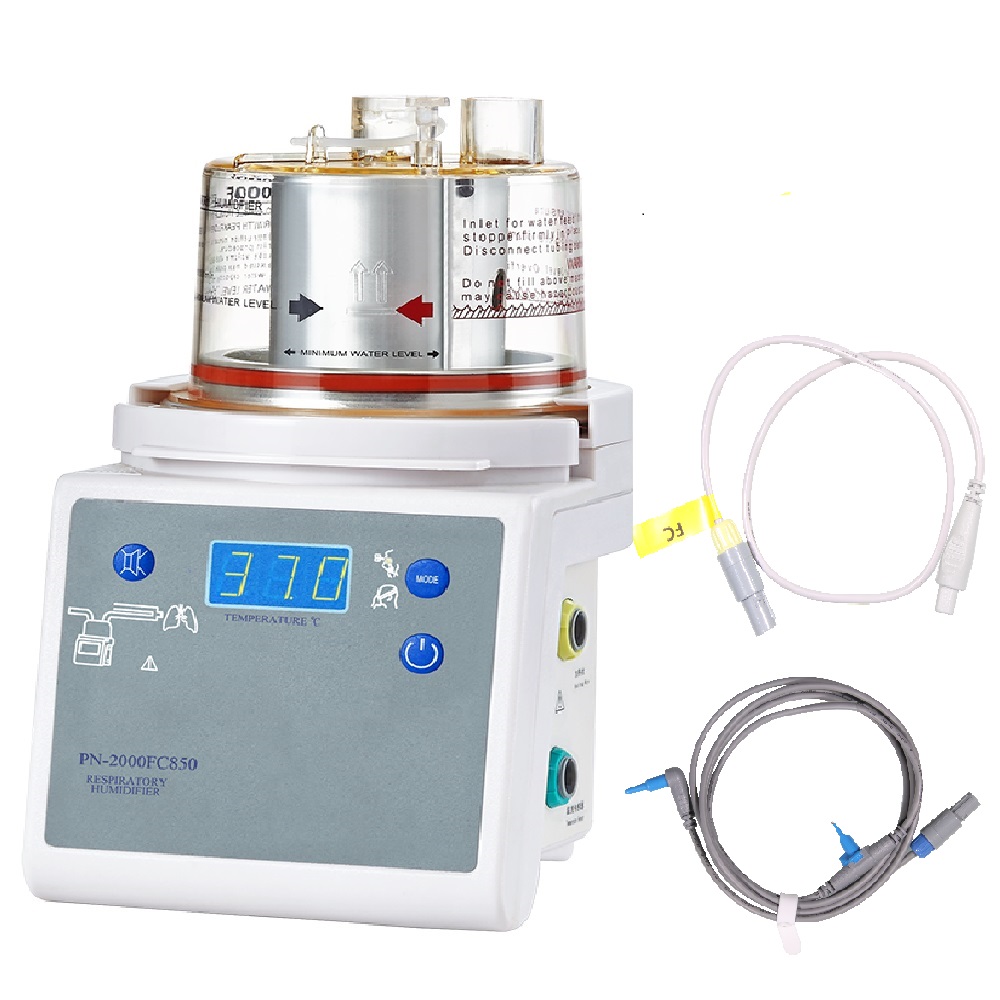
Because humidity follows temperature, the quality of a humidifier is measured by how precisely it holds temperature. The PN-2000FC850 uses servo-controlled heating with dual temperature sensing - a heated-wire socket plus a separate temperature probe - holding temperature to plus or minus 0.3 degrees C across the 25-45 degrees C control range. In invasive mode it maintains a chamber outlet of 35.5-37 degrees C with the airway at 35-40 degrees C; in non-invasive mode the chamber outlet runs at 31 degrees C with the airway at 28-34 degrees C. Those defined bands are what deliver gas in the clinically standard humidity range (about 33-44 mg H2O/L at body conditions) automatically, shift after shift.
Setting different humidity for different patients
Because humidity follows temperature, 'adjusting the humidity' in practice means adjusting three things: the temperature setpoint (higher setting, more evaporation capacity), the flow rate (higher flows need more heater power), and the mode (invasive protocols run warmer airway targets than non-invasive CPAP). The FC850 covers both modes on one unit, and the PN-2000FB offers three heated-wire levels (typically 27, 32 and 37 degrees C) for wards that prefer fixed gears.
What to check when comparing humidifiers
When a quotation promises 'humidity control', ask exactly how it is achieved: Is heating servo-controlled against a temperature probe, or open-loop? What is the temperature accuracy? Are invasive and non-invasive modes defined with actual target temperatures? Are high and low humidity-temperature alarms included? A manufacturer that answers these four questions with specific numbers is a manufacturer that has engineered the system - the rest are quoting a heater in a box.
Frequently asked questions
Does the FC850 control humidity level?
Through precise temperature control - the industry-standard method. The servo system holds the set temperature within plus or minus 0.3 degrees C, and the delivered humidity follows inside the clinically standard band automatically.
Which model should I choose - FB or FC850?
The PN-2000FB offers three heated-wire gear levels for CPAP wards; the FC850 adds dual temperature modes with a 10-70 degrees C range and LED temperature display for units that want full adjustment. Both are manufactured in the same ISO 13485 factory with the same fittings.
Next step
If you are specifying humidification for a neonatal or adult respiratory programme, the team at Pigeon Medical will send the mode and settings table, the documentation pack and FOB/DDP pricing - reach us through the contact form on this site or via the email and phone listed on the Contact Us page.