Sep 17, 2026Neonatal Care
How to Choose an ICU Air Compressor for Anesthesia , Ventilators, and CPAP Machines?
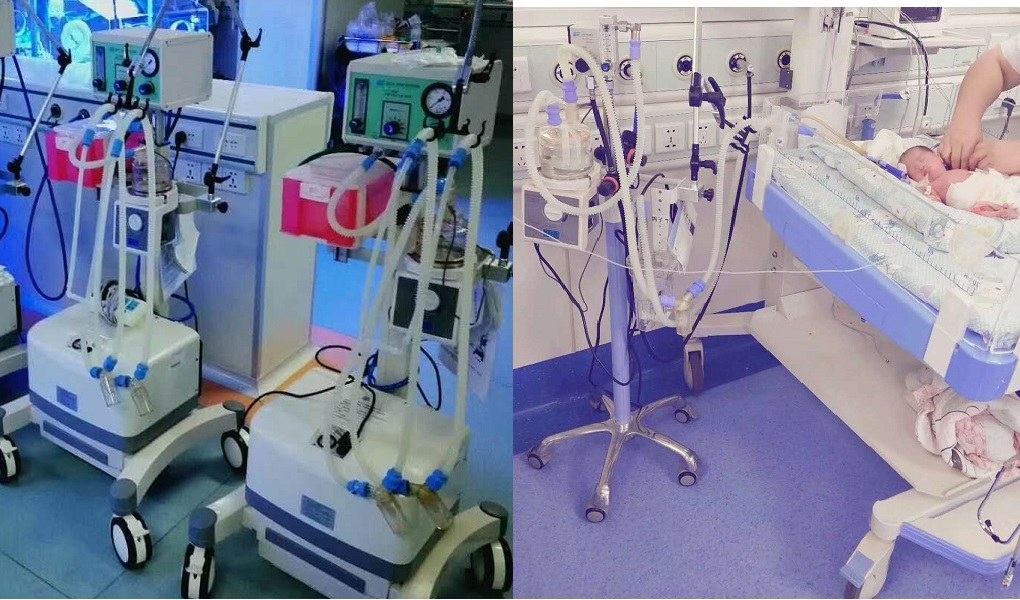
Choosing the right medical air compressor mainly depends on output pressure, output flow, brand matching, & 1or 2 outlet of the-medical-air-compressor your need ? This guide explains the key facto
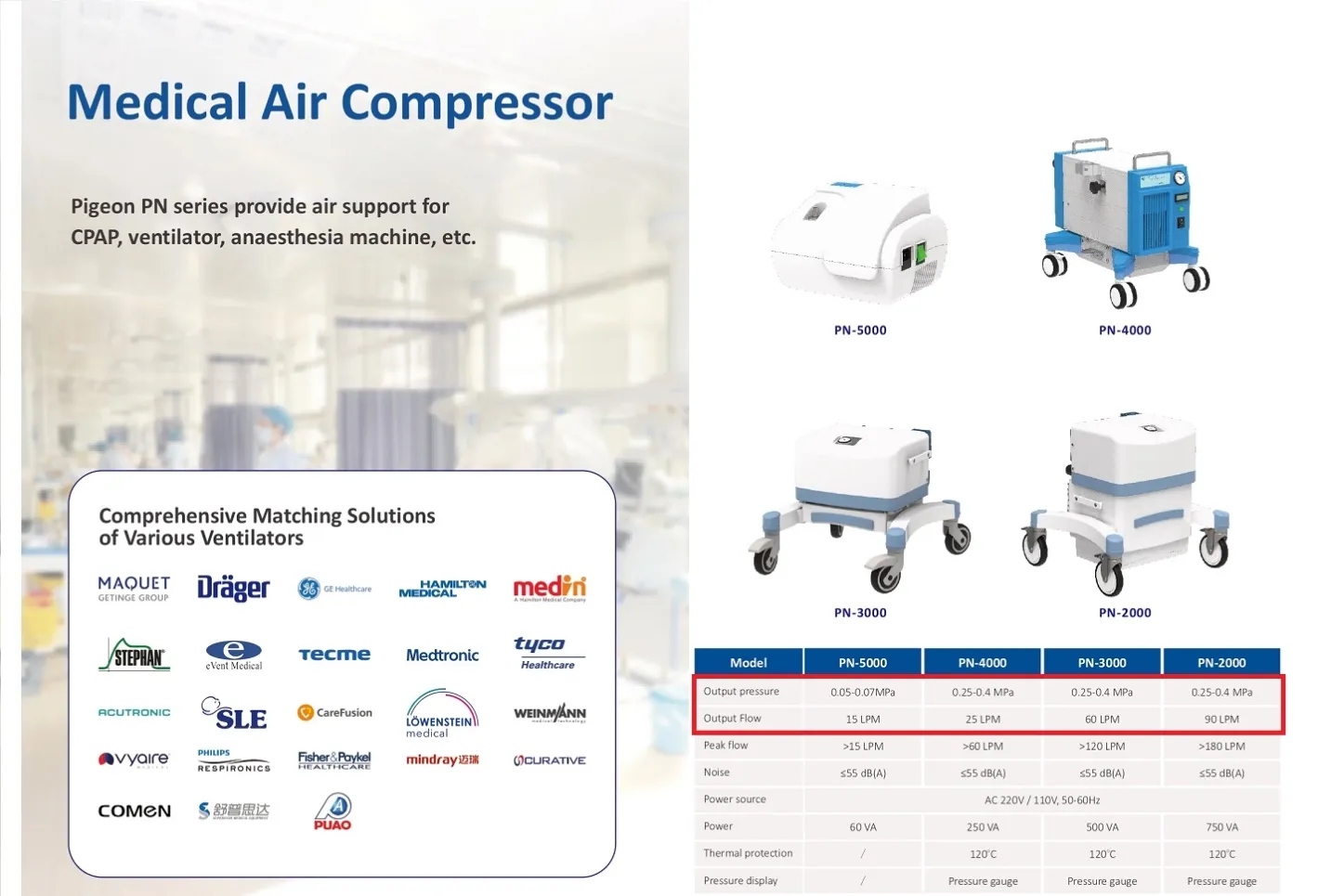
Choosing the right medical air compressor mainly depends on output pressure, output flow, brand matching, & 1or 2 outlet of the-medical-air-compressor your need ?
This guide explains the key factors so you can compare models before sending an inquiry.
We have written it the way we usually explain things to distributor during a 1st conversation — using our own Pigeon Medical PN series as a example, so every point can be checked against a real datasheet rather than left as theory. If any section raises a question about your own device, you are welcome to send us the model number and we will look at it with you.
Which machine will the compressor be serving?
The short answer: start from the device at the end of the hose, not from the compressor. Your device family quietly sets the pressure class, the flow class, and the duty cycle all at once — and the three families below sit in very different ranges.
The reason is simple. Anesthesia machines and ICU ventilators receive air as a driving force, so they expect a fairly high, tightly regulated pressure. CPAP interfaces and resuscitators receive air close to the patient, so they expect a low and gentle one. The difference between the two groups is roughly twenty times in pressure, which is why one compressor rarely serves both well.
Device family | What the air is used for | Typical pressure class | Typical flow class | Duty |
|---|---|---|---|---|
ICU / NICU / PICU ventilator | Positive-pressure drive air, or backup for wall air | High, 0.25–0.4 MPa class | Continuous, 40–60 L/min class | Continuous |
Anesthesia machine | Drive gas for the breathing circuit and pneumatic valves | High, 0.25–0.4 MPa class | Continuous, matched to circuit size | Continuous |
CPAP / air-oxygen blender / infant resuscitator | Blended or low-pressure flow to the patient interface | Low, 0.012–0.018 MPa class | ≥10 L/min class | Often intermittent |
For ICU, NICU and PICU ventilators
These run continuously, so the compressor is expected to hold its pressure window across a whole shift rather than for a few minutes. In our own range this is the PN-3000: 60 L/min output flow, 0.25–0.4 MPa output pressure, and a start-with-pressure mode that restarts the pump automatically once tank pressure falls below 0.5 MPa — a detail that matters when nobody is standing beside the machine.
For anesthesia machines
Anesthesia machines ask for the same pressure class as ventilators, so in most configurations the same PN-3000 class applies. What tends to differ is the outlet arrangement: an anesthesia machine is often placed beside a second device, which is why the PN-3000 offers a double outlet as an option. It is worth deciding the outlet count at the inquiry stage rather than after delivery.
For CPAP, air-oxygen blenders and infant resuscitators
Here the target changes completely. The Pigeon Medical PN-5000 is designed for exactly this group — CPAP, air-oxygen blender and baby resuscitator support — with an output pressure of 0.012–0.018 MPa, output flow ≥10 L/min, a 220 × 160 × 160 mm footprint, and a weight of about 3 kg. It is an intermittent-operation unit, which matches how these devices are typically used.
What output pressure do you need?
The short answer: match your device's required input pressure to the compressor's output pressure, and convert units before you compare. If it falls inside the range, the compressor can serve it; if it does not, no other specification will rescue the match.
A quick unit conversion, since suppliers quote differently
Different regions and different manufacturers quote pressure in MPa, bar or psi. A simple conversion first saves a lot of confusion later:
Quoted value | MPa | bar | psi (approx.) |
|---|---|---|---|
PN-5000 lower limit | 0.012 MPa | 0.12 bar | 1.7 psi |
PN-5000 upper limit | 0.018 MPa | 0.18 bar | 2.6 psi |
PN-3000 lower limit | 0.25 MPa | 2.5 bar | 36 psi |
PN-3000 upper limit | 0.4 MPa | 4 bar | 58 psi |
The three pressures that are easy to mix up
On the Pigeon Medical PN-3000 datasheet you will see three different pressure figures, and each one answers a different question:
- Output pressure, 0.25–0.4 MPa. This is the regulated pressure delivered to your ventilator or anesthesia machine. This is the number to compare against your device requirement.
- Exhaust pressure, ≥0.7 MPa. This is the internal capability of the pump and storage tank before regulation — useful headroom rather than a delivery promise.
- Start pressure, >0.5 MPa. The tank pressure at which the pump restarts automatically, which is what keeps supply steady without an operator nearby.
So when a quotation shows only one pressure figure, it is worth asking which of the three it is. They are not interchangeable, and they tell you different things about how the unit will behave at your bedside.
Why a lower pressure is not a lower grade
For CPAP, an air-oxygen blender or an infant resuscitator, the PN-5000's 0.012–0.018 MPa is the requirement rather than a limitation. Choosing a high-pressure unit "for extra safety margin" in this case can add cost, noise and footprint without adding any real benefit — the interface was designed around a gentle, precisely controlled flow.
What output flow do you need?
The short answer: add up the continuous demand of everything connected, then check that the compressor's rated flow comfortably covers it — and confirm whether the unit is built for continuous or intermittent duty.
Continuous duty versus intermittent duty
A flow figure only means something next to a duty cycle. In our own range the contrast is clear:
- PN-3000 — 60 L/min, continuous-duty design. It starts with pressure and carries high-temperature and overheat protection so it can run through a shift. This is the ICU and anesthesia profile.
- PN-5000 — ≥10 L/min, intermittent operation. A compact support unit for CPAP and resuscitation support, weighing about 3 kg.
How to add up the demand
If a ventilator, a blender and a resuscitation bag share one air source, it is the total that sets the requirement — not the largest single device. When the total sits very close to the rated flow, pressure can soften under load, so the next model up or a second outlet is usually the more comfortable choice.
What peak flow tells you
Peak flow covers short bursts: recruitment manoeuvres, bagging, or a second device opening briefly at the same time. A unit can hold its rated flow and still dip during a peak, so if a peak flow figure appears on a spec sheet it is worth reading as burst capability and confirming the continuous rating separately.
Which brand does it need to work with?
The short answer: a compatible brand list is a helpful starting point, and three practical details turn it into a confirmed match.
How brand matching works in practice
Our Pigeon Medical PN-3000 has been supplied alongside a broad range of ventilator and anesthesia platforms, including MAQUET, Dräger, HAMILTON, GE Healthcare, Philips, Mindray, Fisher & Paykel, Medtronic, Vyaire, SLE, ACUTRONIC, Löwenstein and others, together with a number of domestic Chinese brands. Over time this has given us a fairly wide library of successful configurations — which is often the fastest way to shorten a customer's evaluation.
Three details worth confirming with any supplier
- Connector and port type. Does the compressor outlet mate with your device's air inlet, and how many outlets are needed?
- Pressure window. Your device's required input pressure should sit inside the compressor's output range, with regulation holding it steady.
- Duty cycle and air quality. If your device runs continuously, the compressor should be built to run continuously, and should deliver oil-free, dry air.
If you send us your device model, we will check it against the configurations we have already supplied. That way the answer comes from a working setup rather than from a brand list alone.
What air quality and outlet arrangement do you need?
The short answer: for anything connected to a patient airway, the air should be oil-free and dry, and the outlet should match how many devices you intend to feed.
Oil-free air and the drying system
The PN series uses a micro oil-free reciprocating piston design, with Gast/Thomas oil-free pump cores, SMC and NORGREN pneumatic components, and an ORIENTAL MOTOR cooling fan. On the drying side, a hermetic refrigerated gas drying system cools and dehumidifies the air, condensing saturated water vapour and oil mist into droplets, which are then separated and discharged automatically through the drainage system. Compressed air passes the intake filter, is pressurised by the pump, stored in the tank, regulated to the set output pressure, then passes through the refrigerated cooling module and oil-mist separator before leaving as dry, constant-pressure air.
Single outlet or double outlet
- A single outlet suits one ventilator or one anesthesia machine.
- A double outlet, optional on the PN-3000, suits two nearby devices sharing one air supply.
This is the "No. 1 outlet" decision — the physical interface your device will actually connect to — so it is worth settling before ordering.
The filter cup and water trap
The external filter cup and water trap protect both the compressor and the equipment it feeds. If the water level rises too high it should be drained promptly, and it is a good habit to check it regularly. The intake air filter cotton is best cleaned or replaced weekly to keep performance stable over the long term.
What about noise, power and placement?
The short answer: in an ICU or NICU these three decide whether the compressor can sit near a patient at all, so they are worth checking early rather than at the end.
Noise
Both the Pigeon Medical PN-3000 and PN-5000 are rated ≤55 dB(A). That comes from the double sound-absorbing air duct, a streamlined long duct path, optimised motor vibration design, and sound-absorbing cotton filling. In a patient room this is not a comfort detail — it is part of whether the unit is suitable for bedside placement at all.
Power supply and consumption
Model | Power supply | Power consumption | Approx. current at 220 V |
|---|---|---|---|
PN-3000 | AC 220 V / 50 Hz | 500 VA | ≈ 2.3 A |
PN-5000 | AC 220 V / 50 Hz | 30 VA | ≈ 0.14 A |
Sizing the socket and circuit for the actual current is more reliable than reading the VA label alone. If your site runs 110 V / 60 Hz, it is worth telling us in advance so we can confirm the correct voltage variant.
A few installation points worth checking early
- Place the unit on as flat a surface as possible, and remove the transport fixing device before use.
- The power supply network should have an earth ground connection.
- Operate in a well-ventilated area, and not in an environment with flammable or corrosive gases.
- The socket should meet the rated current and hold firm contact — loose contacts can lead to poor connectivity or a fire hazard.
- Clean or replace the intake air filter cotton regularly; weekly is suggested.
- Drain the external filter cup regularly so water build-up does not affect the compressor or the supported device.
Mobility is part of the design as well: 2 universal wheels plus 2 lockable swivel casters, with anti-collision caps on the leg edges for protection during movement.
How do the Pigeon Medical PN models compare?
The short answer: the PN-5000 and PN-3000 are not a small and a large version of the same thing — they serve two different device classes, and the table below shows where each one fits.
| PN-5000 | PN-4000 | PN-3000 | PN-2000 |
|---|---|---|---|---|
Typical application | CPAP, air-oxygen blender, infant resuscitator | Ask us for the datasheet | ICU / NICU ventilator, anesthesia machine | Ask us for the datasheet |
Output pressure | 0.012–0.018 MPa | Ask us | 0.25–0.4 MPa | Ask us |
Output flow | ≥10 L/min | Ask us | 60 L/min | Ask us |
Exhaust pressure | — | Ask us | ≥0.7 MPa | Ask us |
Start mode | Intermittent operation | Ask us | Start with pressure, start pressure >0.5 MPa | Ask us |
Noise | ≤55 dB(A) | Ask us | ≤55 dB(A) | Ask us |
Power supply / consumption | AC 220 V 50 Hz, 30 VA | Ask us | AC 220 V 50 Hz, 500 VA | Ask us |
Thermal protection | 120 °C, overheat protection | Ask us | High temperature and overheat protection | Ask us |
Pressure display | — | Ask us | Pressure gauge | Ask us |
Timer | — | Ask us | 0–9999 H | Ask us |
Size | 220 × 160 × 160 mm | Ask us | 580 × 580 × 490 mm | Ask us |
Weight | About 3 kg | Ask us | — | Ask us |
The two confirmed columns already show the selection logic: device class first, then pressure and flow inside that class.
What should you prepare before asking for a price?
The short answer: five pieces of information are usually enough for us to quote the right model on the first reply instead of the third.
- Device type and model — ventilator, anesthesia machine, CPAP, blender or resuscitator, with brand and model number.
- Required input pressure — from your device manual, in MPa, bar or psi, whichever it uses.
- Required flow — continuous demand, plus peak if your protocol has one.
- Outlet requirement — how many devices, single or double outlet, and the connector standard.
- Site conditions — voltage and frequency (for example 220 V / 50 Hz), room type (ICU, NICU, operating room, dental), and whether the compressor will run continuously or intermittently.
If some of these are not on hand yet, sending the device model alone is still a good start — we can often work the rest out with you.
Frequently asked questions
Can one compressor serve a ventilator and a CPAP device at the same time?
Generally it is better to treat these as two separate pressure classes, since ventilator-class units regulate at 0.25–0.4 MPa while CPAP-class units regulate at 0.012–0.018 MPa. Feeding both from a single regulated outlet would mean one of them receives a pressure it was not designed for. If you have a shared-air situation in mind, tell us the devices and we will look at whether a multi-outlet configuration can work for you.
Is ≤55 dB(A) quiet enough to place inside a patient room?
That is the rated figure for both the PN-3000 and PN-5000, achieved through multi-layer duct and vibration design. Whether it suits a specific room also depends on your local noise policy and the distance to the patient, so it is worth sharing the room type with us and we will advise on placement.
Why is the exhaust pressure (≥0.7 MPa) so much higher than the output pressure (0.25–0.4 MPa)?
The exhaust pressure reflects the internal capability of the pump and tank, which gives the unit headroom to hold a stable output as demand changes. Only the regulated output pressure reaches your equipment.
Can the PN series run on 110 V / 60 Hz?
The specifications above are AC 220 V / 50 Hz. If your site uses a different supply, let us know the voltage and frequency and we will confirm whether a suitable variant is available, rather than have you receive an incompatible unit.
Is certification documentation available for your compliance file?
The PN-3000 is documented with GB 9706.1 in our technical material. We are happy to share the relevant certificate with you so your compliance team can review it directly.
Next step
If you already know your device model and its required pressure and flow, sending those three numbers is the quickest route. If you are still comparing, starting from the machine family works well: a ventilator or anesthesia machine points towards the PN-3000 class, while CPAP, air-oxygen blender and resuscitator point towards the PN-5000 class.
- Browse the full medical air compressor range to compare the PN series side by side.
- Read how to install and maintain a medical air compressor before your unit arrives.
- Contact our sales engineers with your device model, required pressure and required flow — we will confirm the matching model and outlet configuration for you.
Post editor fields (copy into the CMS, not into the article body)
- Post title: How to Choose an ICU Air Compressor for Anesthesia Machines, Ventilators, and CPAP
- Summary / description: Choosing a medical air compressor for ICU ventilators, anesthesia machines or CPAP mainly comes down to output pressure, output flow, brand matching and outlet arrangement. Using the Pigeon Medical PN series as an example, this guide explains each factor and what to prepare before sending an inquiry.
- Slug: how-to-choose-icu-air-compressor
- Category: Medical Air Compressor
- Tags: medical air compressor, ICU air compressor, ventilator air compressor, anesthesia machine air supply, CPAP compressor, oil-free air compressor
- Heading styles to set in the editor: all section titles above as H2, all sub-questions as H3 (select the text, then choose H2 / H3 from the editor style menu — not bold).
Internal links to wire up (replace the example.com URLs)
Device family | What the air is used for | Typical pressure class | Typical flow class | Duty |
|---|---|---|---|---|
ICU / NICU / PICU ventilator | Positive-pressure drive air, or backup for wall air | High, 0.25–0.4 MPa class | Continuous, 40–60 L/min class | Continuous |
Anesthesia machine | Drive gas for the breathing circuit and pneumatic valves | High, 0.25–0.4 MPa class | Continuous, matched to circuit size | Continuous |
CPAP / air-oxygen blender / infant resuscitator | Blended or low-pressure flow to the patient interface | Low, 0.012–0.018 MPa class | ≥10 L/min class | Often intermittent |